Layering Closed-Cell Foam Under Inflatable Pads for R-Value
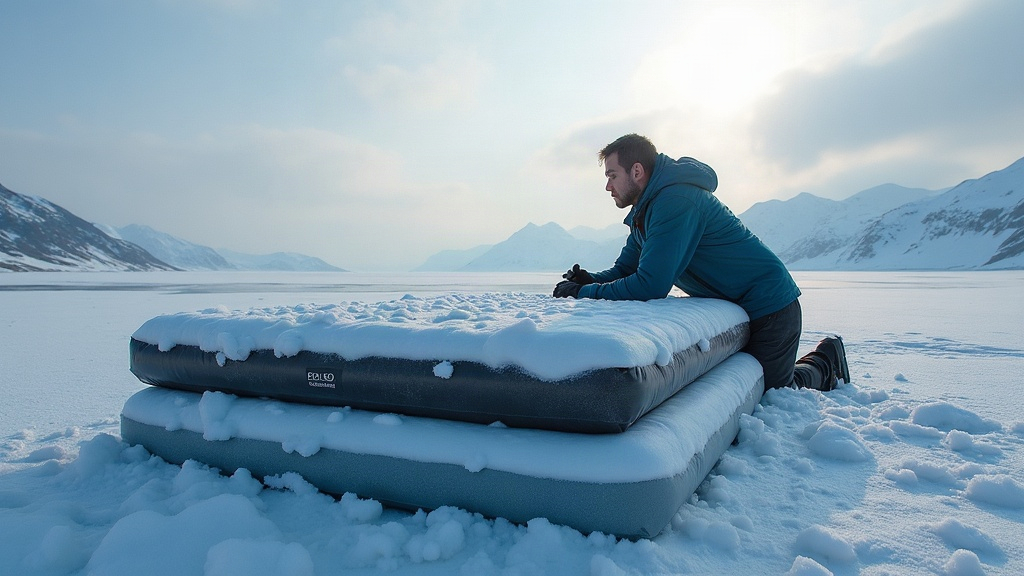
Sleeping directly on glacial ice ranks among the toughest thermal tests you’ll face in the backcountry. One inflatable pad, even a pricey high-R-value model, frequently falls short. Conductive heat loss straight into the ice can have you shaking awake at 2 a.m., wondering why your “winter-rated” gear isn’t cutting it. The fix that seasoned glacier travelers swear by: stack a closed-cell foam pad underneath your inflatable, so the two R-values combine into a system that can actually handle sub-zero ice contact night after night.
Why Glacial Ice Demands a Layered System
Ice punishes you thermally in a way snow or dirt simply doesn’t. Snow traps air pockets and offers some natural insulation on its own. Ice does the opposite: it pulls heat out of your body fast, with next to no buffering in between. Camp on a glacier and you’re fighting several things at once:
- Constant cold transfer – ice sits at or near 32°F (0°C) all night long, no exceptions.
- Moisture and condensation – melted or refrozen moisture pooling under your tent chips away at whatever insulation you’ve got left.
- Wind-driven cold – glacier camps usually sit wide open, no rocks, no trees, nothing to block the wind, which jacks up your overall heat demand.
A pad marketed at R-5 or R-6 as “winter ready” sounds reassuring, but that number was almost certainly tested on relatively dry, non-conductive ground. Not solid ice.
How R-Value Stacking Actually Works
Here’s the good news: R-values add up when you stack pads. Say your inflatable sits at R-4.5 and you throw a closed-cell foam pad rated R-2 underneath it. Your combined system lands around R-6.5. This isn’t some marketing gimmick either, it mirrors how insulation batts stack inside a wall cavity: more layers, more resistance to heat flow.
Why this particular pairing works so well:
- Foam on the bottom takes the abuse: abrasion, punctures, and the worst of the conductive cold radiating up from the ice.
- Inflatable on top brings the loft, the comfort, and a much better R-value-per-ounce ratio than foam can offer by itself.
- Redundancy matters – if your inflatable pad springs a leak overnight (and on sharp glacial ice, that’s a real possibility, not paranoia), the foam underneath still gives you a baseline of insulation. You won’t wake up on bare ice at 3 a.m. with a flat pad and no backup plan.
Recommended Pairings
For serious glacier work, you want a combined R-value somewhere in the 7 to 9+ range, depending on how long you’re out there and how cold it’s going to get.
- Budget setup: Therm-a-Rest Z Lite Sol (R-2.0) paired with a mid-range inflatable like the Therm-a-Rest ProLite (R-3.2) gets you to roughly R-5.2. Workable for shoulder-season glacier trips, not ideal for a deep-winter push.
- Serious winter setup: Nemo Switchback (R-2.0) plus the Therm-a-Rest NeoAir XTherm NXT (R-7.3) brings you to around R-9.3. That’s a solid number for sustained ice camping, multi-night expeditions where you can’t afford a bad night.
- Ultralight-conscious option: Cut the foam pad down to torso length only. You shave weight while still shielding your core, the zone that actually matters most when things get cold.
Practical Setup Tips
- Foam goes on the tent floor first, inflatable on top. Don’t reverse this order. An inflatable pad’s air chambers lose efficiency fast when they’re in direct contact with ice, so the foam needs to be the barrier layer, not the other way around.
- Trim foam to torso length if ounces matter to you. Your legs can get by with a bit less insulation than your core and kidneys need.
- Don’t rely on foam alone in extreme cold. Foam by itself rarely climbs above R-2.5, which just isn’t enough for a genuine ice bivvy below 20°F (-6°C).
- Watch for compression creep. Inflatable pads have a habit of sliding off-center during the night. A slightly wider foam base underneath helps keep everything lined up where it should be.
Common Mistakes to Avoid
- Skipping the foam layer because “my inflatable’s rating is high enough already.” Those ratings come from lab testing, not from a night spent on real ice fighting moisture and wind at the same time.
- Using beat-up, old foam. A pad that’s been compressed for years loses a meaningful chunk of its original R-value. Check the density before you commit it to a big trip, not after.
- Forgetting a ground tarp. A footprint underneath the foam cuts down on moisture wicking up from the ice and into your whole sleep system.
Final Thoughts
Stacking closed-cell foam under an inflatable pad isn’t some overcautious redundancy habit, it’s a method grounded in actual physics, and it works. Combining R-values lets you tune your insulation to match exactly what your trip demands, while the foam doubles as insurance if your inflatable gets punctured halfway through the expedition. If you’re planning serious time on glacial ice, this two-pad setup isn’t extra gear you’re hauling for no reason. It’s often the one thing standing between a decent night’s sleep and a long, miserable, heat-draining one.